Authors: Guillem Anglada-Escude, Sheddad Kaid-Salah Ferron, Miguel Sureda Anfres
Illustrator: Eduard Altarriba
Publisher: Button Books, 2023 - Published inEnglish 2025
Pages: 55
Grade Level: 3 - 6
ISBN: 978-1787081581
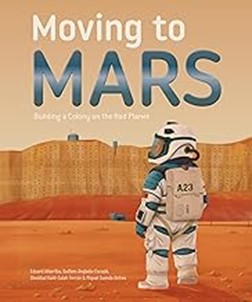
What might it be like to live on Mars? Is it even possible? A few scientists got together and researched this curious idea. They used a study called “The Nuwa Concept: A development model for a self-sustainable city on Mars” plus other studies and used their imagination to come up with some ideas of what it would look like and what might have to happen in order to actually live on Mars. They answered questions like, “What will the journey from Earth to Mars be like? How will we get food and oxygen?”
Traveling to Mars will take approximately ten months. The first thing to do for a settlement on Mars is to set up a base settlement. Pages 32 and 33 show a flow chart of what would be needed and how things would work together. Housing, greenhouses, workshops, laboratories, tanks, energy modules, surface vehicles, etc. all would be needed in order to live on Mars.
Since Mars has a hostile environment and climate, it would be best to build a city underground. Solar panels on the surface would provide electricity and power for the city. Food on Mars would need to include foods that can be produced efficiently and sustainably. Synthetic food, algae, insects, and farm animals are all options for food sources.
I am not a scientist and I do not personally want to travel in space, but it is interesting to imagine what it might be like to live on Mars and what difficulties need to be overcome in order to live there.
Reviewed by Audrey Campbell, MED
Reading Specialist and Library Media Center Director
Valley Adventist Schools, Rogers Campus